The Nameplate Lied Part 2: Reversing Sulfation on an AGM Battery Bank
It's midday. The day after the stress test. The charge controller is in float. The symptom that starts an investigation. The batteries are pushing back every time the controller tries to push current to them. After a night of deep discharge, these batteries should be consuming every watt the solar can deliver. Instead they're refusing the charge.
The last article ended with a diagnosis: sulfation. This article is about the recovery.

THE HISTORY
This shouldn't be happening to batteries that were purchased last October. So I go into the charge controller's history. A battery death event occurred one week before the stress test. I ask my mother how many times the batteries have died. Her answer: around eight.
That's bad news.
After every death event, these batteries needed an equalization cycle; a controlled overcharge that dissolves sulfate crystals back into the electrolyte. That never happened. Not once. Which means there are likely layers of sulfation on the lead plates, choking the current and preventing the batteries from charging properly. The stress test didn't cause this. It added one more layer to a problem eight death events had already built.
THE CHEMISTRY
To understand the recovery, you have to understand what's physically happening inside the battery.
The electrolyte, the acid, is the medium electrons use to move between the plates. During charging, current drives a chemical reaction between the plates and the electrolyte. The electrical difference between the plates is what stores energy. During discharge, the reaction runs in reverse.

In a fully charged lead-acid battery, all of the sulfate is dissolved in the electrolyte surrounding the plates. During discharge, sulfate migrates out of the electrolyte and deposits onto the plates. Charge the battery promptly and the sulfate dissolves back into the acid. This is the normal cycle.
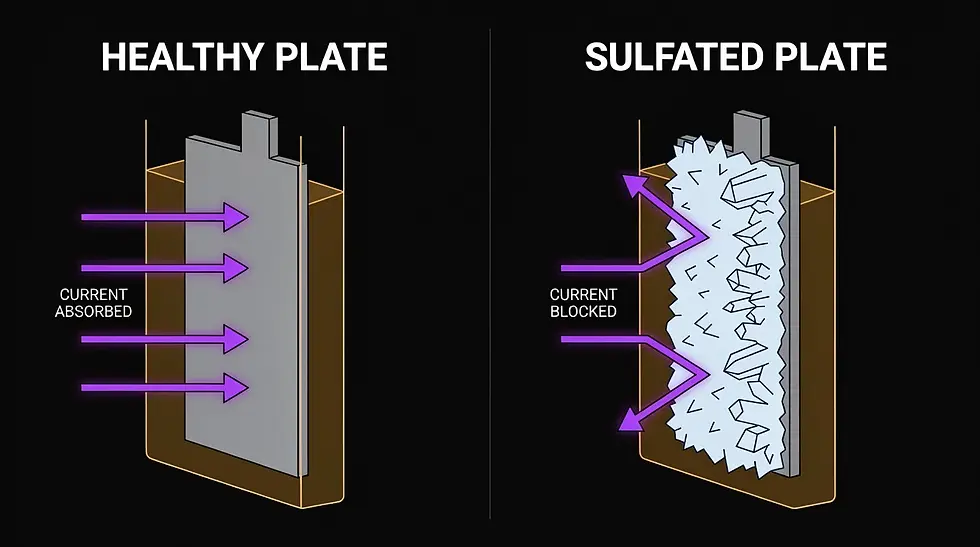
But leave a battery discharged ,or kill it repeatedly without equalizing, and the sulfate hardens into crystals. Hard, impenetrable crystals that coat the plates. This is sulfation, and it's the primary cause of capacity loss in lead-acid batteries.
Right now, those crystals are blocking current from reaching the lead plates. The controller pushes current, the layer of crystals on the lead plates resist it, voltage spikes, and the controller, which reads voltage as its proxy for state of charge, concludes the batteries are full and drops into float. The batteries are being suffocated by their own chemistry.
This is internal resistance. It is inherent to every battery and these batteries resistance is threatening its lifespan.
THE CLOUD EDGE EFFECT
To make matters worse, it's a cloudy day. And clouds introduce a phenomenon most people have never heard of: the cloud edge effect.
When the sun is partially obscured by the edge of a cloud, sunlight refracts and concentrates. For brief windows, the panel receives more irradiance than clear-sky conditions would deliver increasing the power output momentarily.
Normally that's free energy. Today it's a problem. I reset the controller to force bulk charge, but every time a cloud edge crosses the sun, wattage and current spike. The sulfated batteries can't accept the surge. Voltage between the controller and battery jumps. The controller reads high voltage, concludes the batteries are full, and enters the float charging stage, cutting solar input exactly when I need it most.
So the day becomes a manual loop: watch the controller, and every time it enters float, disconnect the solar and battery connections and reset it back into bulk. Over and over.
Despite the conditions, the system delivers 1,985 Wh into the batteries by sundown. Enough to pull them out of the danger zone.
THE COLD NIGHT
The danger now is time and temperature. The longer a lead-acid battery rests discharged, the harder the sulfate crystals become and hardened crystals mean permanent capacity loss. Cold accelerates the hardening. Cold also causes the electrolyte to stratify: the acid settles toward the bottom of the cell, leaving weaker electrolyte at the top.
There's one more failure mode to rule out. If sulfate crystals bridge the gap between plates, they create an internal short. A shorted battery bleeds its own stored energy continuously it is a battery that dies as it sits. So I disconnect the batteries and test them independently, checking voltage every hour through the night.
The results:
Time | Battery voltage (each, resting) |
Nightfall | 12.56 V |
Sunrise | 12.48 V |
Thankfully only 0.08 V was lost overnight. Some drop is expected from the temperature decline alone. An internally shorted battery would have collapsed far more dramatically. The verdict: the batteries are sulfated, but structurally healthy. These batteries can be saved.
THE RECOVERY
Sulfation can only be reversed electrochemically. Violent charge and discharge cycles agitate the electrolyte, physically working the crystals off the plates and back into the acid where they dissolve. The protocol:
Add capacity. I connect my personal solar panels to the system, bringing total array wattage to 650 W. Not a massive increase, but more current means more agitation.
Charge to full. Push the batteries to a complete charge under the expanded array.
Discharge hard. Load the inverter to its maximum ~ 1,000 W. The turbulence of high current moving through the electrolyte softens and dissolves the crystal layer.
Repeat. Full charge, hard discharge, again and again over the following days
At the end of the cycle series, the batteries are performing at the same level as before the stress test.
RESULTS
Parameter | Before recovery | After recovery |
Midday charge state | Float (charge rejected) | Bulk/absorption (normal) |
Overnight self-discharge | 0.08 V (monitored) | Normal |
Charge acceptance | Suffocated by sulfation | Restored |
Capacity at risk | 35–40% permanent loss | Recovered to pre-test performance |
The batteries have been salvaged. A thousand-dollar mistake, avoided through understanding of the chemistry. If I hadn't recognized the float state as a symptom and the controller had sat in float for days while the crystals hardened the batteries would still "work" in the sense of storing and providing energy. But the permanent capacity
loss could have reached 35–40%. Silent, invisible, and unrecoverable.
THE TAKEAWAY
This is why competence matters in off-grid solar. Different chemistries fail differently. Lead-acid sulfates. Lithium-ion can't be charged below freezing without permanent damage. Every battery has failure modes that don't announce themselves and no chemistry forgives an owner who treats the system like an appliance.
While tied to a utility, you pay for operation and maintenance in your bill. The tradeoff is convenience: plug anything into the wall and it works. Until it doesn't. The U.S. Department of Energy's Report on Evaluating U.S. Grid Reliability and Security warns that blackouts could increase by 100 times by 2030 if retiring power sources aren't replaced with firm capacity. That projection is driving more people toward off-grid solutions every year.
But off-grid means you are the owner and operator of a personal power plant. The maintenance bill doesn't disappear it transfers to you, payable in knowledge. Solar is a technology of independence, and independence has a price: you have to understand the machine that powers your life.
These batteries are now operating normally today. The next article covers what it's like on the other side of that tradeoff: living and building a business completely off the grid.


Comments